Brushstrokes Shape Style
You look at a painting and think you're reacting to the subject, a bowl of fruit, a stormy sea, a face. What you feel may come from the brushstrokes themselves, the way the paint sits on the canvas. Change the movement, and you might just change the entire story.
Think of two paintings of the same flower. One done with tiny, smooth, invisible strokes, and one where the artist slapped thick paint on with visible, jagged marks. The first feels calm, almost clinical. The second feels urgent, even angry. You don't need to see the artist's face to know their state of mind.
Movement comes from the mark
Flat, uniform strokes tend to freeze a scene. The eye slides over them without stopping. But when strokes follow a direction, they pull your gaze along with them. Jackson Pollock's drip paintings work this way. The looping, thrown lines of enamel paint create a sense of constant motion, even though the canvas is perfectly still. You track the path of his hand as if the paint were still wet. In a more traditional piece, think of J.M.W. Turner's seascapes. He used sweeping, broken strokes that blur the line between water and sky, so the whole canvas feels like it's churning. The touch becomes the wave.
Texture makes you feel the surface
Paint has physical presence. When an artist uses a palette tool or a heavily loaded brush, the paint rises off the canvas in ridges. You see the impasto in the light, catching shadows in the grooves. That texture adds a tactile layer to the visual one. Rembrandt used this brilliantly in his later self-portraits. He built up the face with thick, rough strokes, then finished the eyes and highlights with a delicate touch. The contrast makes the skin feel weathered and real. You can almost feel the weight of the paint, and that weight translates into a sense of the subject's life experience.
Speed changes the energy
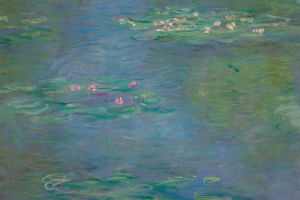
A fast movement leaves a different trace than a slow one. Quick, loose strokes look spontaneous and confident. Slow, careful strokes look deliberate and controlled. The Impressionists, like Claude Monet in his "Water Lilies" series, relied on rapid, broken strokes to capture changing light. Each dab of color is separate, but your eye blends them together from a distance. That speed makes the scene feel fleeting, like a moment caught before it shifts. On the other hand, the laborious, layered strokes of a realist like Andrew Wyeth, in "Christina's World," build a sense of stillness and permanence. The grass in the foreground is painted blade by blade, and that patience shows in the quiet tension of the scene.
The endings that earn it
Some painters hide their strokes entirely, aiming for a photographic smoothness. The Photo-realists of the 1970s, like Chuck Close in his early portraits, used airbrushes to eliminate any trace of the hand. The result is cool and detached. But Close later flipped that, making enormous portraits from thousands of distinct, colored shapes that read as abstract up close. The caress became the subject. So when you look at a painting, ask yourself what the artist chose to show you. Did they want you to see the act of painting, or just the image? That choice is the real style.
Next time you stand in front of a canvas, step closer. Look at the surface before you look at the picture. You'll start to notice the rhythm of the marks, the thick and thin spots, the quick flicks versus the slow pushes. That's where the artist's hand is still talking. Let it tell you what the subject alone can't.
-
 What Makes a Good EndingA good ending doesn't just stop the story. It pays off what you set up and leaves the reader with something to carry.
-
 Choosing a Painting SurfaceExplore the Differences Between Canvas, Wood Panels, and Paper to Achieve Better Texture, Color, and Artistic Results
-
 Walls and CanvasesHow scale, architecture, materials, and working conditions shape the differences between mural and easel painting
Contact to : xyjph123@gmail.com
Privacy Agreement
Copyright © boyuanhulian 2020 - 2022. All Right Reserved.
Privacy Agreement
Copyright © boyuanhulian 2020 - 2022. All Right Reserved.